
Can you have multiple Roth IRAs? Yes, you can absolutely own multiple Roth IRA accounts, but having more accounts does not mean you can save more money.
The Internal Revenue Service (IRS) regulates your total annual contributions across all accounts combined, meaning your personal limit remains exactly the same whether you hold one account or five. Navigating the rigid rules, annual contribution caps, and strategic tracking tips of managing multiple accounts is essential to maximize your tax-free retirement growth while completely avoiding costly IRS penalties.
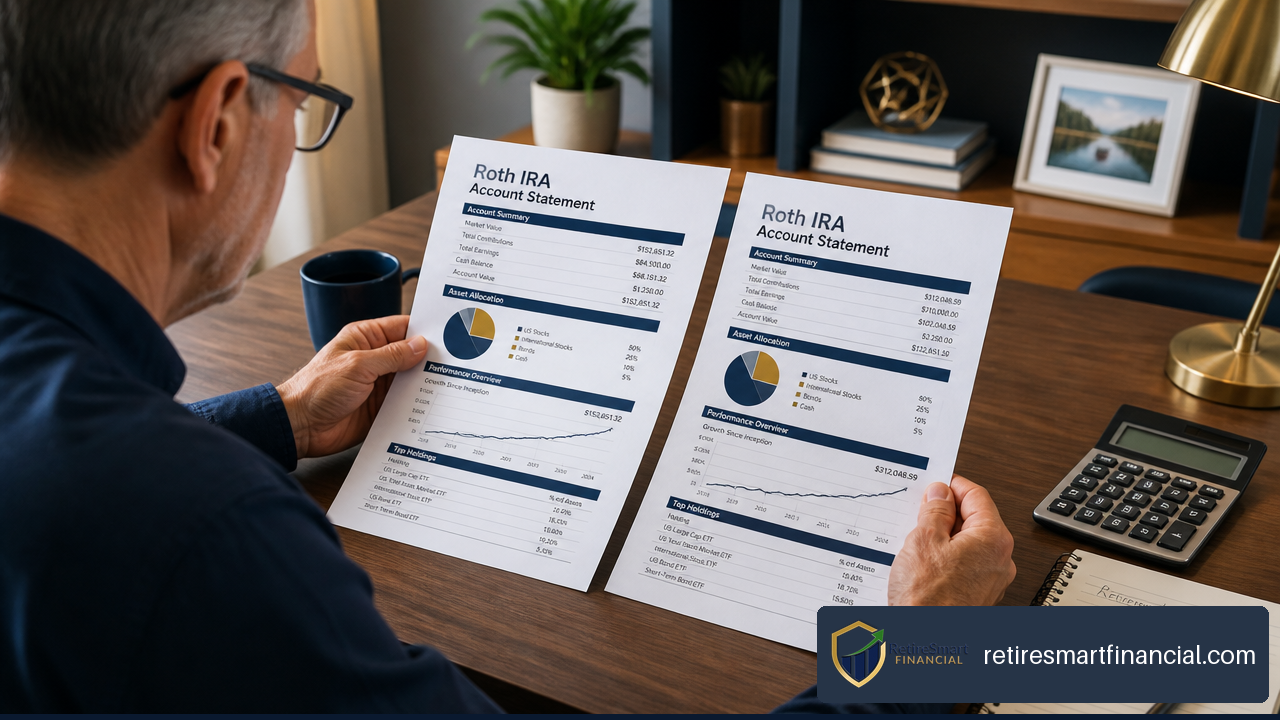
A second Roth IRA can be useful when it serves a clear purpose, such as accessing a specific investment, separating a self managed portfolio from professionally managed assets, or moving to a lower cost provider. Without a purpose, extra accounts can add paperwork, duplicate fees, and make it easier to contribute too much by accident.
Multiple Roth IRA Rules And Contribution Limits
There Is No Limit On The Number Of Accounts
You are legally permitted to open and maintain as many Roth IRA accounts as you want. The Internal Revenue Service (IRS) does not enforce a maximum cap on the number of accounts or financial institutions you can use.
For example, you might choose to hold a Roth IRA at a traditional brokerage to invest in low-cost index funds, while maintaining a separate Roth IRA through an insurance provider utilizing an annuity structure to secure a guaranteed lifetime income stream.
The Annual Limit Is Combined, Not Per Account
The IRS applies a single, aggregated annual limit to all your regular retirement contributions across all your Traditional and Roth IRAs combined.
Your statutory contribution limit is technically restricted to the absolute lesser of the annual IRS maximum or 100% of your personal taxable compensation for that tax year.
Because the federal deadline to fund an IRA for a specific tax year extends until the unextended tax filing deadline of the following spring, you must carefully track your deposits across both the current and previous tax periods to avoid an accidental over-contribution.
The specific combined maximum limits are:
- For Tax Year 2025: Up to $7,000 annually (or $8,000 if you are age 50 or older).
- For Tax Year 2026: Up to $7,500 annually (or $8,600 if you are age 50 or older).
Income And Compensation Restrictions Still Apply
Opening multiple accounts does not provide a loophole to bypass the strict IRS Income Phase-Out Ranges. Your direct eligibility to fund a Roth IRA is strictly tied to your Modified Adjusted Gross Income (MAGI) and your specific tax filing status.
Because the IRS adjusts these thresholds annually for inflation, you must monitor your income carefully across tax years:
- Single / Head of Household Filers:
- 2025 Tax Year: Full contributions are allowed if your MAGI is under $150,000. Partial contributions apply between $150,000 and $165,000, and you are completely phased out at $165,000 or more.
- 2026 Tax Year: Full contributions are allowed under $153,000. The phase-out range occurs between $153,000 and $168,000, meaning you cannot contribute directly if your MAGI is $168,000 or more.
- Married Filing Jointly:
- 2025 Tax Year: Full contributions are allowed under $236,000. The phase-out range spans $236,000 to $246,000.
- 2026 Tax Year: Full contributions are allowed under $242,000. The phase-out range increases to $242,000 to $252,000.
Furthermore, you must have qualifying earned income (like W-2 wages or self-employment net earnings) to participate. If you only earn $4,000 in taxable compensation during the year, your maximum legal contribution limit across all combined IRAs drops down to exactly $4,000, completely overriding the standard standard statutory baseline.ompletely phased out to zero.
For forward-thinking households navigating tax-advantaged retirement savings accounts, a Roth IRA should be viewed as one component of a holistic, broader wealth-building portfolio rather than a tool for unlimited standalone savings capacity.
The High-Earner Solution: The “Backdoor” Roth IRA
If your income exceeds the phase-out thresholds, owning multiple accounts can actually work to your advantage via a legal tax strategy known as a Backdoor Roth IRA.
Using this strategy, high earners open a traditional IRA, make a non-deductible contribution (which has no income limits), and immediately execute a Roth IRA conversion to move those funds into a separate Roth account. While highly effective, you must carefully navigate the IRS “Pro-Rata Rule” if you hold pre-tax funds in any other traditional IRA accounts, as this can trigger an unexpected tax liability.
How To Manage Multiple Roth IRAs
Give Every Account A Clear Job
You should avoid opening multiple Roth IRAs simply to chase short-term signup promotions or slick app interfaces. Managing multiple accounts requires additional administrative effort, meaning a separate account is easiest to justify when it serves a defined structural role.
Assigning distinct buckets allows you to balance growth-oriented investments with retirement income security. The table below breaks down the primary strategic reasons for maintaining separate accounts alongside the operational risks you must watch out for:
| Potential Reason | When It May Help | What To Watch For |
|---|---|---|
| Guaranteed Income Streams | You want to shield a portion of your retirement savings from market volatility using a Roth IRA Annuity for guaranteed lifetime cash flow. | Insurance product guarantees are strictly based on the financial strength and claims-paying ability of the issuing company. |
| Niche Investment Access | You require specialized asset classes or self-directed trading platforms unavailable through your primary custodian. | Fragmented holdings make your true overall asset allocation much harder to track at a glance. |
| Varying Service Models | You prefer automated robo-advisory for one financial goal and active portfolio management for another. | Overlapping management, platform, or advisory fees can quietly erode your long-term returns. |
| Legacy & Estate Planning | You want to keep separate, cleanly organized pools of money designated for specific beneficiaries. | You must review and manually update beneficiary designations at every individual custodian. |
Balancing Market Growth with Guaranteed Income
A common misconception is that holding multiple Roth IRAs automatically creates financial diversification. Separate accounts organize different strategies, but they do not create true investment diversification on their own. For example, if you hold two separate Roth IRAs but both are invested in an identical equity index fund, your money remains heavily concentrated in the exact same underlying assets.
A highly effective multi-account strategy is to split your holdings based on risk and timeline:
- The Growth Bucket (Traditional Brokerage): You utilize one Roth IRA to invest in equities and index funds, maximizing long-term compounding potential during your accumulation years.
- The Security Bucket (Roth IRA Annuity): You utilize a separate Roth IRA structured with an annuity. This allows you to accumulate tax-free growth with built-in downside protection, which can later be converted into a predictable, contractual stream of lifetime retirement income that you cannot outlive.
To maintain a healthy, balanced portfolio, you should consistently review your investments at the aggregate household level. This means analyzing your asset allocation across every retirement account, workplace plan, and cash reserve combined to ensure your risk exposure aligns with your true long-term timeline.
Managing the Logistics: Timelines, Fees, and Transfers
Calendar Year And Tax Year Are Not Always The Same
A common point of confusion for investors is the “overlap period” at the beginning of the calendar year. An IRA contribution made between January 1st and the April tax filing deadline can be designated for either the current or the previous tax year.
For example, if you make a deposit in March 2026, you must explicitly choose whether that money counts toward your 2025 contribution limit or your 2026 contribution limit.
Because your bank or brokerage statements will show both deposits occurring in the same calendar year, it is incredibly easy to lose track of your allocations. Before submitting any deposit, always verify:
- Which specific tax year you are selecting.
- Whether the transaction is coded as a regular contribution, rollover, transfer, or conversion.
- What your combined total is for that specific tax year across every IRA you own.
Review Total Costs, Fees, and Beneficiaries
The number of financial institutions you use matters less than the combined cost and efficiency of your accounts. When managing multiple Roth IRAs, you must look past the marketing headlines and analyze:
- Fund Expense Ratios: A brokerage account with “$0 account fees” can still be expensive if your money is parked in mutual funds with high internal management fees.
- Annuity Mortality & Expense (M&E) Charges: When utilizing a Roth IRA Annuity for guaranteed income, understand the rider costs associated with your downside protection and lifetime distribution guarantees.
- Beneficiary Overlap: Beneficiary designations must be filed individually with each custodian. Opening a new account or consolidating an old one is the perfect time to ensure your primary and contingent beneficiaries align with your current estate plan.

Moving Money: Transfers vs. Rollovers
When shifting funds between multiple Roth IRAs, the method you choose dictates your tax exposure.
Direct Trustee-to-Trustee Transfers
This is the cleanest and safest operational path. The funds move directly from your current custodian to the receiving institution without you ever touching the money. There are no withholding taxes, no calendar deadlines, and no structural risks.
60-Day Rollovers
In an indirect rollover, the current custodian cuts a check directly to you. You then have exactly 60 days to deposit 100% of those funds into another Roth IRA.
- The Risk: If you miss the 60-day window by even a single day, the IRS treats the distribution as a non-qualified withdrawal, potentially triggering income taxes and a 10% early withdrawal penalty on earnings.
- The 12-Month Rule: The IRS strictly limits you to one indirect IRA-to-IRA rollover per rolling 12-month period. This rule applies across all of your combined IRAs, not per account.
When to Consolidate vs When to Keep Multiple Accounts
Consolidating your retirement funds into a single, comprehensive account makes sense when your duplicate accounts serve no unique purpose. Bringing your funds under one roof minimizes your administrative burden by reducing passwords, streamlining tax reporting, simplifying your required minimum distribution (RMD) planning, and providing a clear, bird’s-eye view of your household asset allocation.
You should opt to keep your accounts separate when doing so protects a distinct financial benefit. Good reasons to maintain multiple accounts include:
- Preserving access to a highly specialized institutional fund or self-directed menu.
- Avoiding a steep account closure or transfer-out fee.
- Segmenting your wealth buckets: Keeping one self-directed brokerage account for equity growth and one Roth IRA Annuity dedicated entirely to generating contractual, guaranteed lifetime retirement income.
Roth conversions are a separate decision from holding multiple Roth IRAs. A conversion moves pre tax retirement money, often from a traditional IRA or employer plan, into a Roth account and can create taxable income in the conversion year. Roth conversion strategies should be evaluated based on tax brackets, cash flow, future income expectations, and other household factors, not merely on how many Roth accounts you own.
Multiple Accounts Do Not Multiply Withdrawal Benefits
The IRS views all of your separate Roth IRA accounts as one singular pool when calculating the tax treatment of withdrawals.
Whenever you take a distribution from any of your Roth IRAs, the IRS dictates that the money is withdrawn in a strict order:
- Regular Contributions (Always tax-and-penalty-free)
- Conversions (Tax-free, but subject to a 5-year holding rule)
- Earnings (Tax-and-penalty-free only if you are 59½ and meet the 5-year rule)
Because your individual account statements will only display the activity for that specific custodian, you must maintain your own historical ledger. Retain all copies of Form 5498 (IRA Contribution Information) and Form 1099-R (Distributions From IRAs) across all institutions to prove your true tax basis to the IRS during retirement.
Frequently Asked Questions
Can I have more than one Roth IRA?
Yes. You can legally open and maintain multiple Roth IRAs at the same financial institution or across several different brokerages and insurance companies. There is no statutory IRS limit on the number of accounts you can hold.
Does each Roth IRA have its own contribution limit?
No. Your annual contribution limit is a shared cap that applies across all your Traditional and Roth IRAs combined. For 2026, your total combined contribution limit is $7,500 ($8,600 if you are 50 or older), regardless of how many individual accounts you hold.
Can I contribute to both a Roth IRA and a Traditional IRA in the same year?
Yes. You can split your annual contribution between both account types. However, the total combined amount deposited into both accounts cannot exceed your statutory annual limit for that tax year.
Do rollovers or transfers count against my annual contribution limit?
No. Direct trustee-to-trustee transfers and properly executed rollovers do not count toward your annual contribution limit. You can transfer an unlimited amount of existing Roth IRA assets between custodians without affecting your ability to make standard annual contributions.
What happens if I accidentally exceed the combined contribution limit?
If you over-contribute due to tracking errors across multiple accounts, the IRS imposes a 6% annual excise tax penalty on the excess amount for every year it remains in the account. To fix this, you must contact your custodian immediately to execute a Removal of Excess Contribution along with any net income attributable (NIA) to those funds before your tax filing deadline.
Is it better to have multiple Roth IRAs or consolidate them?
It depends entirely on your strategy. If your duplicate accounts hold identical investments, consolidation will simplify your life and reduce fees. However, keeping separate accounts is highly advantageous if you are deliberately separating a market-growth brokerage account from a Roth IRA Annuity meant to provide guaranteed lifetime income.