
A Roth conversion strategy moves money from a traditional IRA or eligible employer retirement account into a Roth IRA, paying income tax now in exchange for potential tax free qualified withdrawals later. The central question is not simply whether to convert. It is whether paying tax at today’s marginal rate could be better than paying tax on future withdrawals, required minimum distributions, and potential legacy transfers.
For many households, the best answer is neither “convert everything” nor “never convert.” It is a measured, multi year plan that fits available tax brackets, cash flow, Medicare rules, and retirement income needs.
Table Of Contents
• How A Roth Conversion Strategy Works
• Choosing The Right Conversion Timing
• Managing Pro Rata Rules And Five Year Rules
• RMDs, Medicare, And Distribution Risks
• Frequently Asked Questions
• Sources
How A Roth Conversion Strategy Works
A conversion changes the tax treatment of retirement money. You generally move assets from a traditional IRA, SEP IRA, SIMPLE IRA, or eligible workplace plan into a Roth IRA. The converted amount is usually included in ordinary income for that tax year. It does not receive capital gains tax treatment simply because investments inside the account have appreciated.
The tradeoff is straightforward: pay a known tax cost today to create a pool of money that may be withdrawn tax free later if qualified distribution rules are met. Roth IRAs also do not require lifetime required minimum distributions for the original owner. That can create more flexibility when deciding which accounts to tap in retirement.
The Three Ways To Complete A Conversion
The operational method matters because mistakes can create avoidable paperwork, missed deadlines, or temporary loss of tax sheltered status. The IRS recognizes three methods for converting a traditional IRA: a rollover, a trustee to trustee transfer, or a same trustee transfer. The IRS describes these permitted Roth conversion methods as distinct ways to complete the transaction.
| Conversion Method | What Happens | Practical Consideration |
|---|---|---|
| Rollover | You receive the funds, then deposit them into a Roth IRA | Usually carries the most operational risk because deadlines apply |
| Trustee To Trustee Transfer | One institution sends funds directly to another | Often simpler because you do not take possession of the money |
| Same Trustee Transfer | The institution relabels or transfers funds internally | Often efficient when both accounts are held at the same firm |
A direct transfer is frequently easier to document and less likely to create an accidental missed deadline. A rollover can work, but it requires careful handling. If money is paid to you, the redeposit deadline is generally 60 days. That is a poor place for casual timing.
A Roth IRA must be established and designated as a Roth IRA, rather than merely treated as one later. The IRS explains this account distinction in its Roth IRA account guidance. That may sound technical, but account setup errors can complicate a conversion that otherwise looks simple on paper.
Conversion Is Different From A Roth Contribution
A Roth contribution is new money placed directly into a Roth IRA, subject to annual contribution limits and income eligibility rules. A Roth conversion moves existing retirement funds from one tax category to another.
This distinction matters for high earners. Someone may be ineligible to make a direct Roth IRA contribution yet still be able to convert traditional IRA funds. There is no income limit for a traditional IRA to Roth IRA conversion. The decision is driven by tax cost, not income eligibility.
Key Takeaways
• A conversion creates taxable ordinary income in the year it is completed.
• Partial conversions can be more useful than all at once conversions because they allow annual bracket management.
• A Roth conversion can reduce future RMD pressure, but it may increase current taxes, Medicare premiums, and other income based costs.
• The best strategy usually compares several years of projected income rather than focusing on a single tax return.
A Roth conversion is not automatically a tax saving move. It is a decision to pay tax at a chosen time, with the goal of improving lifetime flexibility.
Choosing The Right Conversion Timing
The strongest Roth conversion opportunities often appear during temporary low income years. Examples include the period after retirement but before Social Security begins, a year between jobs, a year with unusually low business income, or years before RMDs begin.
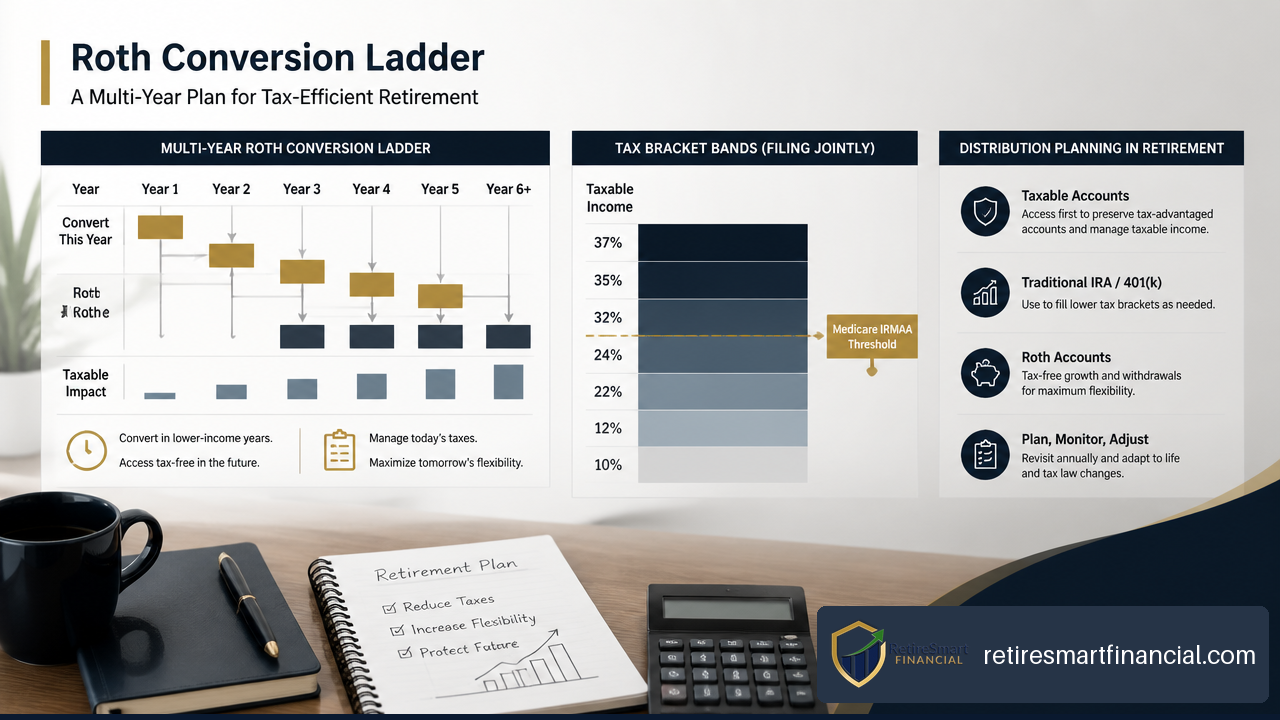
The logic is marginal tax rate management. If a household has taxable income that places it near the middle of a tax bracket, it may convert only enough to use the remaining room in that bracket. This is commonly called “filling the bracket.” Converting up to a selected tax bracket is a practical way to manage conversion taxes over time.
Calculate Bracket Headroom Before Choosing A Dollar Amount
A useful starting point is to estimate taxable income without the conversion, then identify how much room remains before the next relevant threshold. That threshold is not always just a federal tax bracket.
For example, assume a retired couple expects $140,000 of taxable income before a conversion. If their planning target is to remain below a specific bracket ceiling, they might have $35,000 of room available. Converting $35,000 may be reasonable. Converting $100,000 could push a large portion of the conversion into a higher marginal rate and trigger other income based costs.
The goal is not always to pay the lowest possible tax this year. Sometimes it is rational to pay a moderate tax rate today to avoid potentially larger distributions and higher tax rates later.
Why Calendar Timing Matters
A Roth conversion counts for the tax year in which it is completed. Unlike IRA contributions, which may sometimes be made for the prior tax year by the tax filing deadline, a conversion completed in January counts for the new calendar year, not the year that just ended.
That makes late December timing important. If a conversion is intended for the 2026 tax year, it generally must be completed by December 31, 2026. Waiting until early 2027 does not allow it to be reported as a 2026 conversion.
Fair warning: institutions may have their own processing cutoffs before December 31. A request submitted on the final business day may not settle in time. A plan should allow room for operational delays.
Pay The Tax Deliberately
Using cash outside the retirement account to pay conversion tax often preserves more of the converted balance inside the Roth IRA. That leaves more money available for potential tax free growth.
Withholding tax from the conversion can be convenient, but it reduces the amount that reaches the Roth IRA. For someone under age 59½, the withheld amount may also be treated as a distribution rather than a converted amount, creating a possible early distribution penalty unless an exception applies.
Tax payments also require timing. A large conversion late in the year may increase estimated tax needs. Withholding from wages, pensions, or certain retirement distributions can sometimes be treated as paid evenly throughout the year for underpayment purposes, while estimated payments are credited based on when paid. The details depend on the household’s full tax situation, so the payment method should be coordinated before the transaction is processed.
The Five Year Rules Are Not One Rule
People often hear “the five year rule” and assume there is one clock. There are separate timing rules for Roth IRA qualified distributions and for converted amounts.
For converted amounts, each conversion can have its own five year period for purposes of the 10% additional tax on early withdrawals. This primarily matters for individuals under age 59½ who may need to withdraw converted principal soon after converting. Early access planning should happen before, not after, a conversion.
For Roth earnings, qualified distribution treatment generally depends on a different five year period beginning with your first Roth IRA contribution or conversion year, plus a qualifying event such as reaching age 59½. The distinction can be easy to miss.
RMDs, Medicare, And Distribution Risks
RMDs are a major reason many retirees evaluate Roth conversions. Traditional IRA and most pretax workplace retirement balances can eventually require taxable distributions. If account values grow over time, RMDs can rise even when you do not need the money for spending.
A Roth conversion reduces the traditional IRA balance that may later be subject to RMD calculations. It does not eliminate RMDs already required for the year. If you are subject to an RMD, that RMD generally must be taken first and cannot itself be converted to a Roth IRA.
Tax Brackets Are Only Part Of The Cost
A conversion can affect more than federal income tax. It may change:
• Medicare Part B and Part D premiums through IRMAA.
• The taxable portion of Social Security benefits.
• Capital gains tax rates or the net investment income tax for some households.
• State income taxes, depending on your state of residence.
• Eligibility for income based credits, deductions, or health insurance assistance.
Medicare IRMAA is especially important because it generally uses modified adjusted gross income from two years earlier. A large 2026 conversion could affect Medicare premiums in 2028. Reviewing the IRMAA brackets for 2026 alongside tax bracket headroom can help reveal whether a conversion crosses a premium threshold.
Social Security And Distribution Sequencing
Once Social Security begins, additional ordinary income may cause more of the benefit to become taxable. A conversion does not reduce Social Security itself, but it can influence the tax calculation surrounding those benefits.
This is why retirement income sequencing matters. A Roth IRA can provide tax flexibility later: withdrawals from a qualified Roth IRA may not add to taxable income in the same way as traditional IRA distributions. In practice, that may help a household manage a large one time expense, stay below a Medicare threshold, or avoid stacking withdrawals on top of RMDs.
This is not a promise that Roth withdrawals will always lower taxes. The value depends on future tax law, spending, investment results, and household income. But a diversified mix of taxable, tax deferred, and Roth assets can give you more choices when those variables change. Broader Retirement planning insights can help place conversion decisions within an income and distribution plan.
Where Annuities May Fit, With Care
Certain annuity designs are sometimes discussed as part of a Roth conversion strategy because they may provide contract features such as a premium bonus, principal protection subject to the insurer’s claims paying ability, or tax deferred growth. In some cases, a household may be able to use income from contract features to help manage the cash flow impact of conversion taxes.
An annuity may be worth evaluating when principal protection and predictable income are higher priorities than full liquidity.
Frequently Asked Questions
What Is A Roth Conversion Strategy?
It is a coordinated plan for converting part or all of pretax retirement money into a Roth IRA over one or more years. The strategy weighs current taxes against potential future benefits, including tax free qualified withdrawals, smaller future RMDs, and more flexible retirement income withdrawals.
How Much Should I Convert Each Year?
There is no universal dollar amount. Start with projected taxable income, subtract it from the top of your selected tax bracket, then test the result against IRMAA and other thresholds. A partial annual conversion often reduces the risk of turning a favorable tax move into an expensive one.
Should I Convert During A Low Income Year Or Spread Conversions Over Time?
A low income year can be attractive because more conversion dollars may fit into lower brackets. Spreading conversions can be better when a one time conversion would create a higher bracket, an IRMAA surcharge, or a larger estimated tax burden. The right answer depends on projected income across several years, not just this year’s bracket.
Can I Convert Part Of My IRA Instead Of The Whole Account?
Yes. Partial conversions are allowed and often form the basis of a conversion ladder. You might convert a planned amount each year until RMDs begin or until a target portion of retirement assets is held in Roth accounts.
How Do Roth Conversions Affect Medicare Premiums?
A conversion increases modified adjusted gross income for the year of conversion and may affect Medicare IRMAA two years later. The increase can create a higher effective marginal cost than the tax bracket alone suggests. Review both tax and Medicare thresholds before finalizing the amount.
Do I Need To Pay Conversion Taxes From Outside Money?
It is often more efficient to use outside funds when available because the full conversion amount reaches the Roth IRA. Paying tax from the converted account reduces the amount that can potentially grow in the Roth and may create an early distribution issue for someone under age 59½.
Is A Roth Conversion Worth It If I Expect Lower Taxes Later?
Determining whether a Roth conversion makes sense when expecting lower retirement taxes requires looking beyond basic tax brackets to how your future income streams will interact. While standard math favors delaying taxes if your future rate drops, retirement often introduces complex interactions—like Required Minimum Distributions (RMDs), the taxation of Social Security, and IRMAA Medicare surcharges—that can drive your actual effective tax rate much higher than anticipated. Because tax laws change and a single assumption can expose you to a future “tax torpedo,” it’s important to run multi-scenario projections to evaluate the long-term trade-offs of paying taxes now versus later.
At RetireSmart Financial, we build personalized income, tax, and protection roadmaps for adults 55+, families, high-net-worth households, and business owners. Founder and CEO Anh Le brings a former Big 4 CPA tax-consulting background to these conversations, which shapes how we model conversion timing alongside RMD projections, IRMAA exposure, and legacy goals. If you want to see what a coordinated conversion sequence could look like for your own accounts, you can schedule a free consultation and walk through it with us.